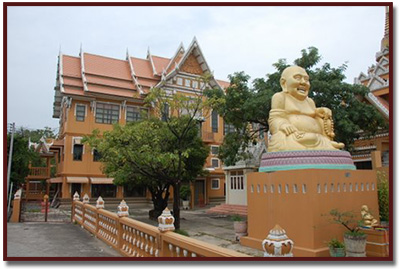
Wat Thepthidaram was built by King Rama III in 1836 for his daughter, Princess Kroma Muen Apsomsudathep. It was originally called ""Wat Ban Phrayakrai Suanluang".
Located on Mahachai Road in Bangkok, the temple was built with a mixture of Chinese architectural styles. Sunthon Phu, one of Thailand’s greatest poets, had resided in this temple during his monkhood from 1840 - 1842.

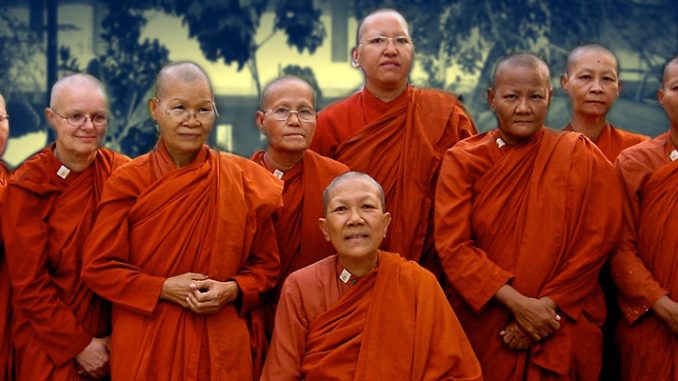
"Phra Mae Mahapajapati Gotami Bhikkhuni Theri Sitting with Bhikkhuni Disciples". This photo was taken at Wat Thepthidaram in Bangkok in its Bhikkhuni Vihara. There is this image of Mahapajapati Gotami, the Buddha's stepmother and one of his Foremost Disciples, together with unique images of 52 bhikkhunis surrounding her.Located on Mahachai Road in Bangkok, the temple was built with a mixture of Chinese architectural styles. Sunthon Phu, one of Thailand’s greatest poets, had resided in this temple during his monkhood from 1840 - 1842.

The Buddha's teaching to his venerable foster mother in the Gotami Sutta (Anguttara Nikaya VII.53):
"I have heard that at one time the Blessed One was staying at Vesali, in the Peaked Roof Hall in the Great Forest.
Then Mahapajapati Gotami went to the Blessed One and, on arrival, having bowed down to him, stood to one side. As she was standing there she said to him: "It would be good, lord, if the Blessed One would teach me the Dhamma in brief such that, having heard the Dhamma from the Blessed One, I might dwell alone, secluded, heedful, ardent, & resolute."
"Gotami, the qualities of which you may know, 'These qualities lead to passion, not to dispassion; to being fettered, not to being unfettered; to accumulating, not to shedding; to self-aggrandizement, not to modesty; to discontent, not to contentment; to entanglement, not to seclusion; to laziness, not to aroused persistence; to being burdensome, not to being unburdensome': You may categorically hold, 'This is not the Dhamma, this is not the Vinaya, this is not the Teacher's instruction.'
"As for the qualities of which you may know, 'These qualities lead to dispassion, not to passion; to being unfettered, not to being fettered; to shedding, not to accumulating; to modesty, not to self-aggrandizement; to contentment, not to discontent; to seclusion, not to entanglement; to aroused persistence, not to laziness; to being unburdensome, not to being burdensome': You may categorically hold, 'This is the Dhamma, this is the Vinaya, this is the Teacher's instruction.'"
That is what the Blessed One said. Gratified, Mahapajapati Gotami delighted at his words."
From: http://www.accesstoinsight
The teaching in this sutta is important because it focuses on recognition of specific fundamental qualities or characteristics of the Path of Practice to know whether a teaching is rightly Dhamma and Vinaya and the Buddha's Teaching or not. This is very nice for interfaith and interreligious dialogue work, and is also and important tool in the field of Buddhist Text Critical Studies.
It is also very important for anyone and everyone to help us be able to know for ourselves whether what someone is teaching and propounding -- whether just a friend or someone who is revered as a great teacher -- is in accordance with Dhamma-Vinaya or not.
"I have heard that at one time the Blessed One was staying at Vesali, in the Peaked Roof Hall in the Great Forest.
Then Mahapajapati Gotami went to the Blessed One and, on arrival, having bowed down to him, stood to one side. As she was standing there she said to him: "It would be good, lord, if the Blessed One would teach me the Dhamma in brief such that, having heard the Dhamma from the Blessed One, I might dwell alone, secluded, heedful, ardent, & resolute."
"Gotami, the qualities of which you may know, 'These qualities lead to passion, not to dispassion; to being fettered, not to being unfettered; to accumulating, not to shedding; to self-aggrandizement, not to modesty; to discontent, not to contentment; to entanglement, not to seclusion; to laziness, not to aroused persistence; to being burdensome, not to being unburdensome': You may categorically hold, 'This is not the Dhamma, this is not the Vinaya, this is not the Teacher's instruction.'
"As for the qualities of which you may know, 'These qualities lead to dispassion, not to passion; to being unfettered, not to being fettered; to shedding, not to accumulating; to modesty, not to self-aggrandizement; to contentment, not to discontent; to seclusion, not to entanglement; to aroused persistence, not to laziness; to being unburdensome, not to being burdensome': You may categorically hold, 'This is the Dhamma, this is the Vinaya, this is the Teacher's instruction.'"
That is what the Blessed One said. Gratified, Mahapajapati Gotami delighted at his words."
From: http://www.accesstoinsight
The teaching in this sutta is important because it focuses on recognition of specific fundamental qualities or characteristics of the Path of Practice to know whether a teaching is rightly Dhamma and Vinaya and the Buddha's Teaching or not. This is very nice for interfaith and interreligious dialogue work, and is also and important tool in the field of Buddhist Text Critical Studies.
It is also very important for anyone and everyone to help us be able to know for ourselves whether what someone is teaching and propounding -- whether just a friend or someone who is revered as a great teacher -- is in accordance with Dhamma-Vinaya or not.
These are the venerable Mahapajapati Gotami's verses from the Therigatha [6.6] addressed in homage to her foster son who became the Buddha:
From: http://nt.med.ncku.edu.tw/
It is a moving portrayal of the rounds of samsara, wandering on from birth to birth, male and female, in different roles with one another. I love these words "the source of craving has [now] withered".
She also makes a very excellent point here that connects to the Buddha's own answer to her question to him of how one should honor a Buddha.
Gotami Apadana vv. 170-1 Catthasanghayana Tipitaka Pali (Translation by William Pruitt, PTS, Commentary on the Verses of the Theris)
"Buddha! Hero! Praise be to you!
You foremost among all beings!
You who have released me from pain,
And so many other beings too.
All suffering has been understood.
The source of craving has withered.
Cessation has been touched by me
On the noble eight-fold path.
I've been mother and son before;
And father, brother — grandmother too.
Not understanding what was real,
I flowed-on without finding [peace].
But now I've seen the Blessed One!
This is my last compounded form.
The on-flowing of birth has expired.
There's no more re-becoming now.
See the gathering of followers:
Putting forth effort, self controlled,
Always with strong resolution
—This is how to honor the Buddhas!
Surely for the good of so many
Did Maya give birth to Gotama,
Who bursts asunder the mass of pain
Of those stricken by sickness and death."
From: http://nt.med.ncku.edu.tw/
It is a moving portrayal of the rounds of samsara, wandering on from birth to birth, male and female, in different roles with one another. I love these words "the source of craving has [now] withered".
She also makes a very excellent point here that connects to the Buddha's own answer to her question to him of how one should honor a Buddha.
‘‘‘Kathaṃ carahi sabbaññū, vanditabbā tathāgatā;
Kathaṃ avandiyā buddhā, taṃ me akkhāhi pucchito.
“'Then how is homage paid to the Perfect Ones, O Omniscient One?' [I asked.] 'And how is homage not to be paid to Buddhas? Please reveal to me [the answer] to what has been asked.'
‘‘‘Āraddhavīriye pahitatte, niccaṃ daḷhaparakkame;
Samagge sāvake passa, etaṃ buddhānavandanaṃ.
“'See the disciples all together, putting forth energy,' [he replied,] resolute, always with strong effort. This is homage to the Buddhas.'

go to see
Monastery of the Heavenly Daughter
Bhikkhuni Vihara