Thailand's Rich and Ancient History of Women in Buddhism

Thailand has a rich and ancient history of women in Buddhism, from the 3rd century BCE, when Asokan-era arahant missionaries Sona and Uttara Thera came from India to the ancient land of Suvarnabhumi first sharing the Buddha's teaching, ordaining more than 3,000 noble men and 1,500 noble women as bhikkhus and bhikkhunis. This was the foundation of Buddhism in Thailand, where Buddhism is still very much alive and flourishing to this day, with more than 90% of the population being Buddhists of the Theravada School. Thailand also has many Chinese-Thai Mahayana Buddhists, and an old and recently reviving history of Vajrayana Buddhism. The ancient land of Survarnamubhumi or Suvannabhumi in the Pali-Buddhist language -- the Land of Gold -- used to include all of Myanmar (Burma), Thailand, Laos, Cambodia, and the South of Vietnam and China.

This blog showcases a little of the immense wealth of the rich heritage and history of Thailand's Buddhist women - and of all of the Thai people and culture - from ancient to modern times. We hope you enjoy your Women in Buddhism Tour here and during your stay in Thailand!

(If you enjoy this blog, please be sure to read the "Older Posts" - click link at the bottom of this page. Most more recent posts are focused around Bangkok and Ayutthaya. Older posts are mostly from further afield upcountry in Thailand's Northeast and Northwest.)

Monday, April 11, 2011

Sathira Dhammasathan - Founded by Maechee Sansanee - Bangkok


Sathira Dhammasathan Women's Dhamma Center
An Oasis of Peace in the Heart of Bangkok
Founded by Renowned Thai Buddhist Nun Maechee Sansanee
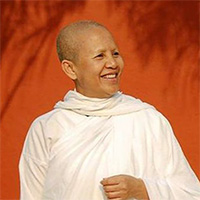


Mae Chee Sansanee Sthirasuta, a Buddhist nun, is the founder and Director of Sathira-Dhammasathan Center, in Bangkok. The Center, under Mae Chee Sansanee’s leadership, believes that Dhamma is holy, when it can be applied in the normal way of living. We also believe that every human being has the potential to live a life that is free from suffering. We believe that people can be different and that, that difference should be respected and accepted.

For the first seven years of her life as a nun, Mae Chee Sansanee studied and practiced meditation with her teacher, which became the foundation of work and ways of living. She started Sathira-Dhammasathan in the year 1987, filling a plot of barren land with trees and ponds, with the intention to make the Center a community place of learning, where people learn to let go of their ignorance and be happy in doing their duty for the betterment of the world. Meditation and Dhamma discourses were the major activities in the first few years and the suffering that Mae Chee noticed and heard from the people attending these courses; led her into other projects, touching the lives of those that suffer and those that originate the suffering. The trail led her through all walks of life, from the rich and successful to the convicts in prisons, from happy families to abused and deserted mothers.

Her remarkable teachings and humanitarian efforts to help break the cycle of violence in communities soon caught the attention of the Thai Government, which has since appointed her in several important and influential positions. In all her work, Mae Chee Sansanee uses Dhamma to bring peace, harmony, respect and open heart, without discrimination or bias into the chaotic world of high power meetings.

Mae Chee Sansanee’s compassion, teachings and projects caught the attention of organizations in other countries and she has been frequently invited to attend well known and widely accepted summits in several countries, as the country representative of Buddhist ordained women, a nun. Where ever and when ever Mae Chee Sansanee goes, she brings with her, peace, compassion and her unconditional love, which shines brightly and touches the hearts of other attendees. Currently, she is Co-Chair for the Global Peace Initiative of Women an organization committed to engaging in inter-faith dialogue as a means of creating world peace, and dedicated to creating both inner and outer peace and harmony in "hot-spots" around the world. As a message of motherhood she works to support youth around the world, as a co-worker with the Global Peace Initiative of Women and the UNDP, preparing for the Global Youth Leadership Summit in 2006.

For more information on Mae Chee Sansanee Sthirasuta and the Sathira-Dhammasathan Center please visit:
www.sansanee.org
www.sathira-dhammasathan.org


In this intimate and moving portrait of her life story, we take a Walk of Wisdom with Mae Chee Sansanee. For the first time, Mae Chee Sansanee shares her life, her work, and her wisdoms, and takes us on a journey from her former days as a top ten model to her life as a nun, and her every day activities of helping others and living a life of peace and true beauty that really does come from the heart

Thursday, March 10, 2011

Foremost Women Disciples of the Buddha Mural - Wat Pho - Bangkok


Wat Phra Chetupon Vimolmangalaram Rajwaramahaviharn
Vasa Vara Jetavana Vimalamangala Arama Raja Maha Vihara


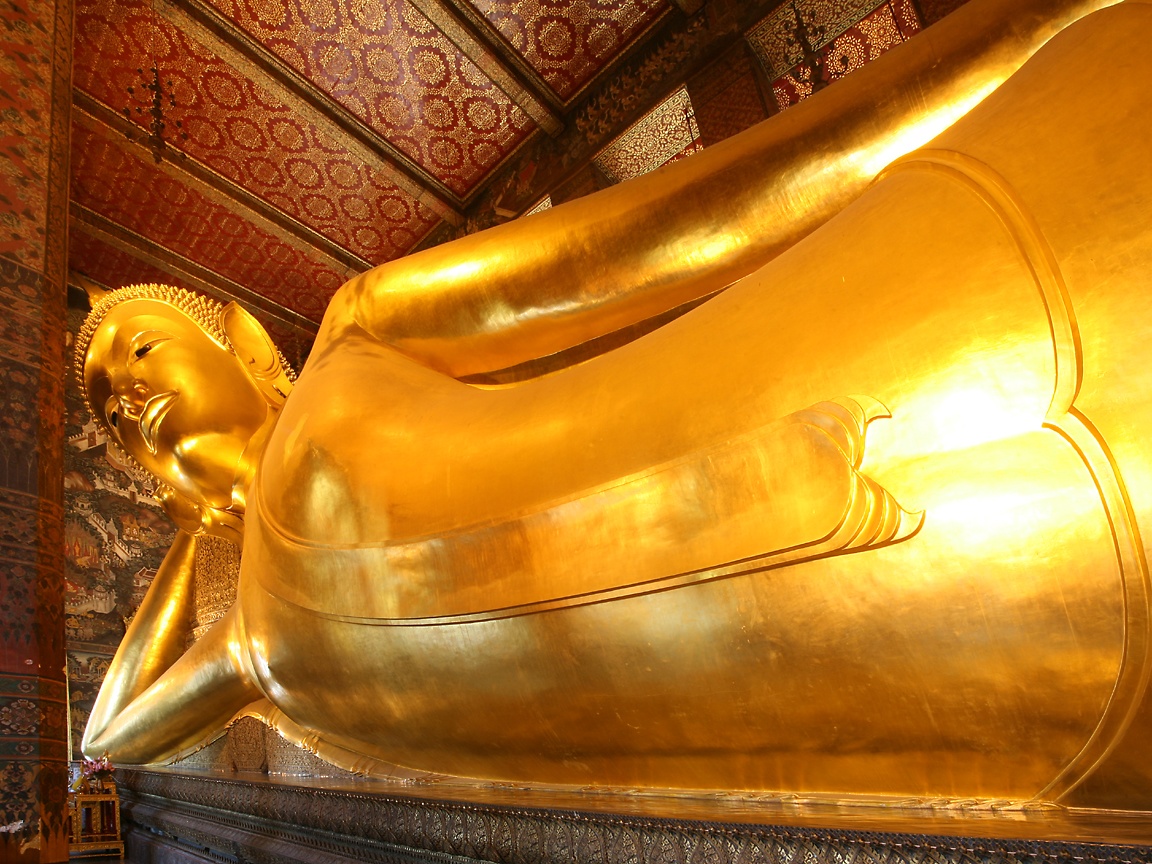
The Foremost Women Disciples of the Buddha wall mural painting is behind the reclining Buddha image in the Hall of the Reclining Buddha at the famous Wat Pho in Bangkok. (You can see it behind the Buddha's head here.) The great wall mural is composed of a coordinated series of excellent paintings illustrating the life stories of the Thirteen Foremost Bhikkhuni Disciples of the Buddha -- the Etadagga Bhikkhuni Savaka -- and the Ten Foremost Laywomen Disciples of the Buddha -- Etadagga Upasika Savaka-- as recorded in the Tipitaka of the Pali Texts.


"Royal Visit". This part of the great wall mural shows a bhikkhuni monastery or "upassaya" (lit "refuge" or "sanctuary") with bhikkhunis inside and a bhikkhuni welcoming the queen who has come with her ladies in waiting bearing gifts.
This shows the days before European jackets and shirts became popular in tropical Asian countries! At that time male and female royalty would often wear vestiments of bands of jewels on their chests, while other folks might wear strips of cloth around their chests and one shoulder. The Thai people used short hair for both men and women then, like the ancient Kambojans. According to the decorations on the gateway, it looks like this monastery is depicted as one with royal patronage.


Photograph of the 'Borisat-si' - Fourfold Assembly of the Buddha wall mural behind the great reclining Buddha image in the Hall of the Reclining Buddha (Viharn Phranon) at Wat Pho (Ayutthayan Period Monastery Wat Bodharam) in Bangkok. Restored by King Rama III and his son Prince Laddawan.


The degree to which the existence of the Bhikkhuni Sangha is an integral requirement for the welfare of the Buddha Sasana and for its stability is highlighted in a teaching of the Buddha's in the Samyutta Nikaya. This teaching points out that for ensuring the healthy and long duration of the Dhamma and for preventing its disappearance, all four assemblies, including the bhikkhunis, should live with respect towards the Buddha, the Dhamma, the Sangha, the Discipline and the development of Samadhi. This passage thus treats the existence of bhikkhunis, and of all four assemblies practicing well, as an integral requirement for the welfare and stability of the Buddha Sasana

[SN 16.13 at SN II 225,8: bhikkhu bhikkhuniyo upasaka upasikayo satthari ... dhamme ... sa ghe ... sikkhaya ...samadhismi sagarava viharanti sappaissa. Ime kho ... pañca dhamma saddhammassa hitiya asammosaya anantaradhanaya sa vattanti.]

To learn more about the Fourfold Assemby of the Buddha aka the Fourfold Sangha see Dignity and Discipline pg 65 - click on the link here.


"The Foremost Teacher". The photo is of painting of the Buddha's bhikkhuni disciple Foremost in Dhamma Teaching - Arahant Theri Dhammadinna Bhikkhuni.

This part of the great mural painting shows the venerable Dhammadinna at her kuti privately and personally speaking with a laywoman. It is said that some women seem to learn better from women, and some from men; and this may vary during one's lifetime. The same holds true for men. It is very important for women to have shining examples, paragons of virtue and enlightened knowledge, together with the experiencial knowledge and compassion of having lived as a woman in this world. This is one of the great blessings and brilliances of the Fourfold Assembly of the Buddha; everyone has someone in their own category -- the category of life that they identify with -- to serve as an enlightened example and guide.

The Venerable Dhammadinna's teaching is uniquely distinguished amongst the bhikkhunis as praised by the Buddha as "Buddhavacana" or the "Buddha's Words". You can find her excellent teaching on the subject of the origin, cessation and the way leading to the cessation of sakkaya - self - personality or identity views in the Culavedalla Sutta, no 44 of the Majjhima Nikaya - the Middle Length Discourses of the Buddha: MN 44: Culavedalla Sutta: http://dhammaweb.net/Tipitaka/read.php?id=78

‎"One should be eager, determinate, mind suffused with awareness.
One whose thought is not attached to sensual pleasures
is called 'she who goes upstream'."

This is the venerable Dhammadinna Theri's single gatha - her single verse of advice directed to her fellow women - that remains to us in the Therigatha (v12) to this day.


Wednesday, February 9, 2011

Chedi of Ayutthaya Queen Suriyothai Monument


Stupa of Queen Sri Suriyothai- Ayutthaya


Wat Chedi Sri Suriyothai

This is the chedi (skt: chaitya - like a stupa or pagoda)
containing the crematory remains of the great Thai heroine,
the ancient Buddhist queen of Ayutthaya, Queen Suriyothai.


Chedi Sri Suriyothai is located on the western part of the City Island near the confluence of the Chao Phraya River and the old Lopbur River (Klong Muang). This area is known as the Hua Laem District, and it is still an important for the local military (an old cantonment was based at this site until recent history).

Chedi Queen Suriyothai was situated opposite of
Wat Sop Sawan at the mouth of a canal. The former was located on the southern side, and the latter was built on the northern side of the canal. Both sites are clearly marked on de La Mare’s 1751 map. The canal has since been filled in and has become a small road. Chedi Si Suriyothai was built on the premises of the Royal garden of the Rear Palace (Wang Lang). Unfortunately, there isn’t anything surviving in situ at the Rear Palace, and Chedi Si Suriyothai stands as its last surviving marker.

Chedi Si Suriyothai consists of a single bell-shaped chedi. Its base is square, and it has many indented corners. It has been gilded with gold paint from the relic chamber to the top of its spire. There is an entrance on the northern side, but it is never open to the public for some reason. A locked courtyard has been constructed around this ruin. To its east is a small park that was built to commemorate the site.

According to Prince Damrong Rajanubhab, this monument contains the ashes of Queen Suriyothai. Royal Chronicles describe her as a heroic wife of King Chakkraphat that died in battle while saving the life of the King. As the story goes, King Chakkraphat and two of his sons were leading an army into battle against the Burmese. Queen Suriyothai, fearing for her family’s safety, secretly dressed as a male soldier and rode an elephant into the fight. While fighting a Burmese general on the back of an elephant, King Chakkraphat’s elephant stumbled, which put him at risk to his opponent’s blade. Queen Suriyothai heroically charged in front of the enemy’s weapon, sacrificing her own life in his place. In her honor, King Chakkraphat had a funeral monument and a preaching hall constructed on the site of her Royal cremation. When it was finished, the King bestowed it with the name Sop Sawan Monastery (Cushman 40-41).


Queen Suriyothai survives as a nationalistic image to promote Thai identity. In 2001, a popular movie was released that portrayed the story of Queen Suriyothai. Chedi Si Suriyothai also influenced architecture in Bangkok during the Chakri dynasty. “Sri Suriyothai Chedi served as the prototype for the chedi which King Rama IV constructed at Wat Pho in Bangkok to join the outer three chedi built by the previous Kings on the Bangkok dynasty” (Kasetsiri & Wright 92).


In 2005, another popular movie was made on the life of Queen Suriyothai's predecessor, Queen Regent Sudachan: The King Maker (Thai: กบฎท้าวศรีสุดาจันทร์ , or The Rebellion of Queen Sudachan)


Click here if you would like to learn more about ancient Thai Buddhist queens

***

Visit
Your resources on old Siam. The history of Ayutthaya gathered by AHR.
Historical research and information on Thailand's cultural world heritage.

Saturday, January 8, 2011

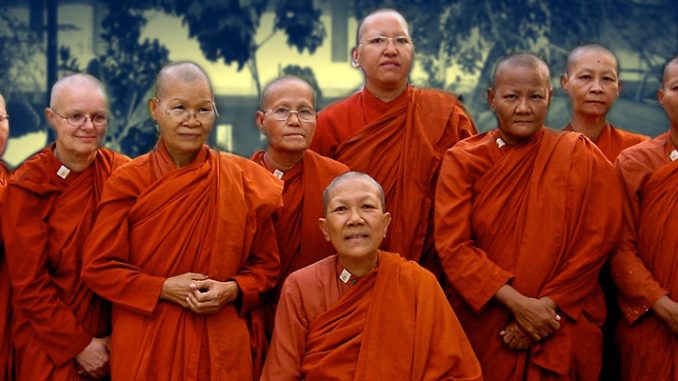
Songdhammakalyani - Ven Dhammananda Bhikkhuni


from www.thaibhikkhunis.org


Songdhammakalyani Temple
This land was purchased from H.M.Indrasakdisaci, Queen of King Rama IV in 1960. Ven.Bhikkhuni Ta Tao Fa Tzu (Varamai Kabilsingh) was the founder and built the Uposathagara (Main chapel) as well as Dhammapisamai school respectively.
Watra Songdhammakalyani is a temple that is completed with Uposatha Hall and Sima boundary as prescribed by the vinaya, therefore it is ready for ordination. The first lower ordination (samaneri) was given by Bhikkhuni Upajjhaya R.Saddha Sumana from Sri Lanka in 2002, and again in 2005 both ordination ceremony were witnessed by Thai bhikkhu sangha. But because the Thai Government has not yet recognized the bhikkhuni status, the temple has not been registered as a temple yet.
However, there is Buddhasavika Foundation that the temple is associated with for its activities.


Usually the temples in Thailand are called “Wat”, but here we have “Watra” which is a Sanskrit word meaning “practice” it is the same as Pali “Wat” (w for v)but in Thailand we prefer to use the Thai spelling “Wat”, all the three words mean the same only they are in different languages.

In 2001 after the ordination of Ven.Dhammananda, she added yet 3 more rai to the existing 6 rai of land which was previously given by Ven.Voramai Kabilsingh.


The Founder


Voramai Kabilsingh was born in 1908 started her education in Catholic school and was the first woman to graduate with physical education. In 1932 she went to Singapore on a bicycle with a group of boy scouts. She spent many years as a journalist and editor of a local weekly magazine. She got married in 1946 to Korkiat Shatsena, a member of parliament and representative of people in a southern province.


She had only one child who later on became Dr.Chatsumarn Kabilsingh and presently Ven.Bhikkhuni Dhammananda.


Ven.Voramai Kabilsingh started her monastic life by receiving the 8 precepts from Pra Prommuni, vice abbot of Wat Bavornnives, the royal residence since Rama IV. Later she went to Taiwan and received full ordination to become a bhikkhuni in 1971, She continued propagating Buddhism through Vipassana Banthernsarn, a monthly Buddhist magazine for 32 years. Also she was regularly involved in social welfare providing food and clothing for the poor and needy. She sponsored ordination of more than a hundred monks through out the country. More than a hundred Buddha images were casted and offered to various far away village temples.

Ven.Voramai Kabilsingh often was known as Ven.Grandma passed away peacefully at a full ripe age of 96 years on June 24,2003.


Second Generation


Ven. Bhikkhuni Dhammananda, the present abbot was born as Chatsumarn Shatsena. She received her education from India and Canada. She spent 32 years teaching as an associate professor at the Department of Philosophy and Religions at the well known Thammasat University in Thailand. She was divorced with three grown sons and three grandchildren.


She took the turn of life in 2000 when she went to receive Bodhisattva’s precept from Fo Guang Shan in Taiwan. The following year, 2001 she went to receive her lower ordination from Sri Lanka. Her female preceptor was Ven.Bhikkhuni R.Saddha Sumana from Tusitarama, Eheliyagoda. Her male preceptor was Ven.T.Dhammaloka of Tapodantamaya, Mt.Lavinia, Colombo.

In 2003 she was ordained as bhikkhuni at the same place, and to further strengthen her lineage she took yet another upasampada in 2005 with her former bhikkhuni Upajjhaya and The Most Venerable Maha Nayaka Sri I.Sumangalo was her bhikkhu Upajjhaya at Dambulla. Her ordination lineage is Syamopali from Dambulla chapter.


Since her ordination she has engaged herself in depth to build a strong foundation for a better understanding of bhikkhuni ordination and for a better understanding of leading a life as a Buddhist. Within the past 5 years she has brought out more than ten books for education of the public.

At the same time her temple is an open space for both men and women, Buddhists and non-Buddhists to come and nourish each other spiritually and physically.


Her temple offers 3-day training courses for public. Students from the US often book to come and enjoy the live-in experience within a monastic setting at the same time receive education of there interest.


The temple also house a Home of Peace and Love providing space and opportunity for underprivileged women and girls to live in a peaceful atmostphere. Girls are sponsored for higher education and training from monastic setting.


Location

Songdhammakalyani Monastry, means the temple of women who uphold dhamma, is situated on Petkasem Hwy, km.52-53 west of Bangkok, just before the proper Nakhonpathom province. Petkasem is a major highway leading west before turning down south, and could continue on to Kuala Lumpur.


Landmark
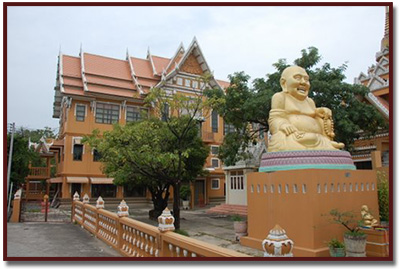
In front of the temple there is a golden laughing Buddha, built some 20 years ago, according to the Ven.Grandmother (Voramai Kabilsingh) “the smiling face of the future Buddha should lessen the unwholesome thought in the mind of the people who see him.”


Songdhammakalyani Monastry 195 Petkasem Highway Muang District, Nakhonpathom Thailand 73000

Tel.& Fax. 66 3428 4315 E- mail :  dhammananda9d@gmail.comdhammananda9d@gmail.com